

Best Product Review Apps for Shopify (2026): Judge.me vs Loox vs Yotpo vs Junip vs Okendo vs Stamped vs Ali Reviews
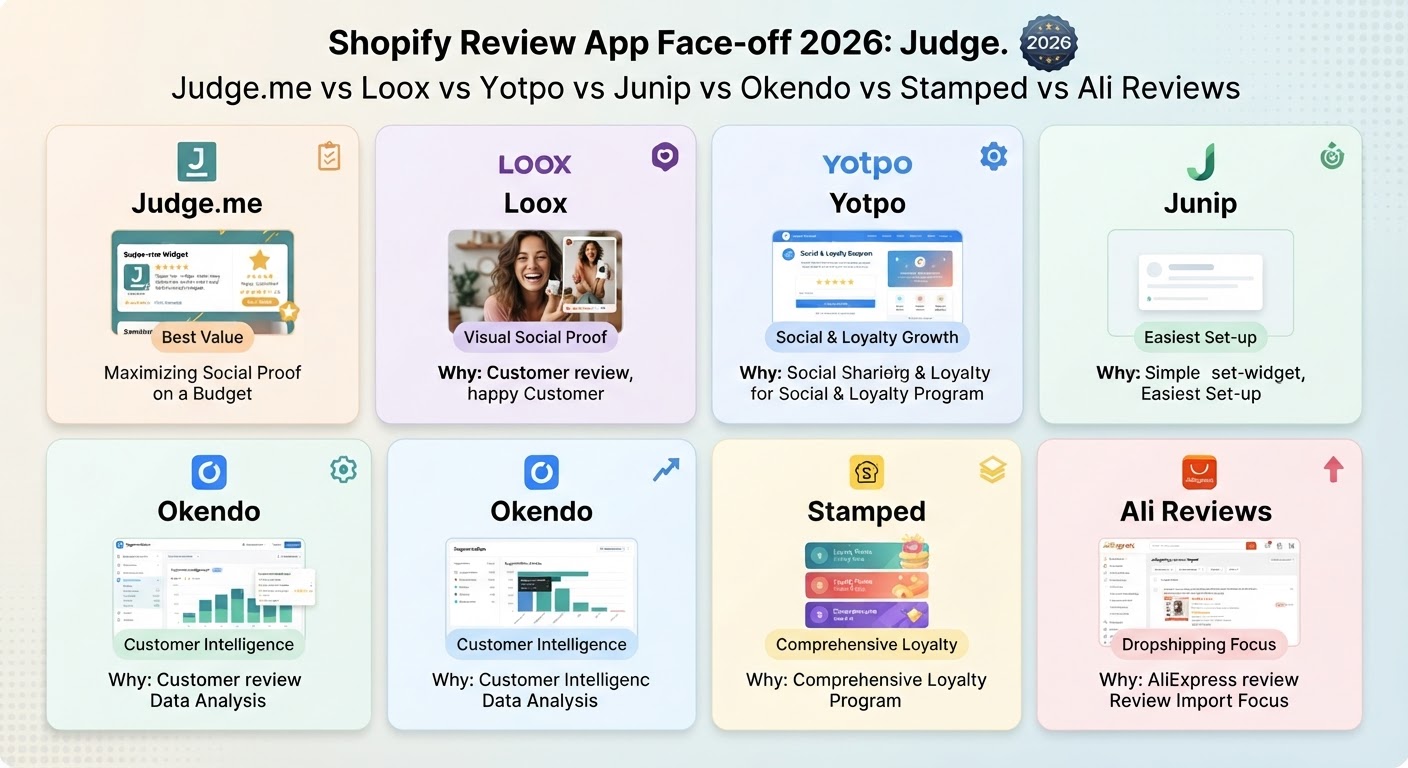
We compared the seven most popular Shopify review apps on pricing, features, performance and support — including Judge.me, Loox, Yotpo, Junip, Okendo, Stamped and Ali Reviews — to find the right pick for every store size and budget.
Product reviews are the cheapest conversion lever a Shopify store has. Time and again, CRO studies show that shoppers trust other shoppers more than they trust your copy, your photography or even your prices. Yet picking a review app on the Shopify App Store is surprisingly hard: seven apps dominate the category, their marketing all sounds the same, and their pricing pages hide order-volume limits that can triple your bill overnight.
In this guide we dig into Judge.me, Loox, Yotpo, Junip, Okendo, Stamped and Ali Reviews — the seven apps that together hold the overwhelming majority of the Shopify reviews market. We compared their pricing structures, collection engines, display widgets, syndication pipelines, integrations and support quality, and scored each of them on the same seven criteria so you can see exactly where one wins and another falls short.
🧩 What a review app actually does
Before comparing vendors, it helps to separate the four jobs a review app performs, because apps are strong or weak at very different stages of that pipeline:
🧪 How we evaluated these review apps
Every app on this list went through the same evaluation grid, based on seven weighted criteria that we use for all tools on this site:
We also weighed what merchants themselves report: each app's recent App Store reviews were sampled for recurring praise and recurring complaints — support speed, outages, billing surprises — and those signals flowed into the Support and Performance scores. Where a vendor's own marketing made a claim we could not verify from merchant evidence, we marked it as a vendor claim rather than a tested fact.
Prices, plan limits and feature lists are current as of September 2026 and were taken directly from the Shopify App Store listings and vendor pricing pages. Public App Store ratings are quoted as of the same date. One honest disclaimer: no two stores are alike, so treat our scores as a starting grid — a visual-first fashion brand and a high-ticket B2B store will weight things differently. Interface screenshots below belong to their respective vendors and are shown for identification purposes in this review.
⚖️ Quick comparison: the seven apps at a glance
Here is the full head-to-head table with criteria scores, overall ratings and verdicts. We will unpack every row in detail below.
Shopify review apps: head-to-head
Criteria scores from our testing methodology. Order volumes, prices and feature sets are current as of September 2026.
| Tool | Score | Ease of use | Features | Performance | Pricing | Support & docs | Free plan | Open source | Verdict | Visit site |
|---|---|---|---|---|---|---|---|---|---|---|
| Judge.me | 9.4 | 9 | 9 | 9 | 9 | 9 | ✓ | — | Best overall value — flat pricing with no order caps | |
| Junip | 8.6 | 9 | 7 | 9 | 8 | 8 | ✓ | — | Best lightweight pick, unlimited orders on every tier | |
| Loox | 8.4 | 9 | 7 | 8 | 7 | 7 | ✓ | — | Best for photo-heavy visual social proof | |
| Okendo | 8.1 | 7 | 9 | 8 | 5 | 8 | ✓ | — | Best enterprise analytics without enterprise pricing | |
| Yotpo | 7.8 | 6 | 10 | 8 | 4 | 8 | ✓ | — | Best if you already run the Yotpo retention suite | |
| Stamped | 7.5 | 8 | 8 | 7 | 7 | 6 | — | — | Solid mid-range option, mind the reliability reports | |
| Ali Reviews | 7.2 | 8 | 6 | 6 | 8 | 6 | ✓ | — | Best budget tool for AliExpress dropshippers |
🏆 Judge.me — the value king of Shopify reviews
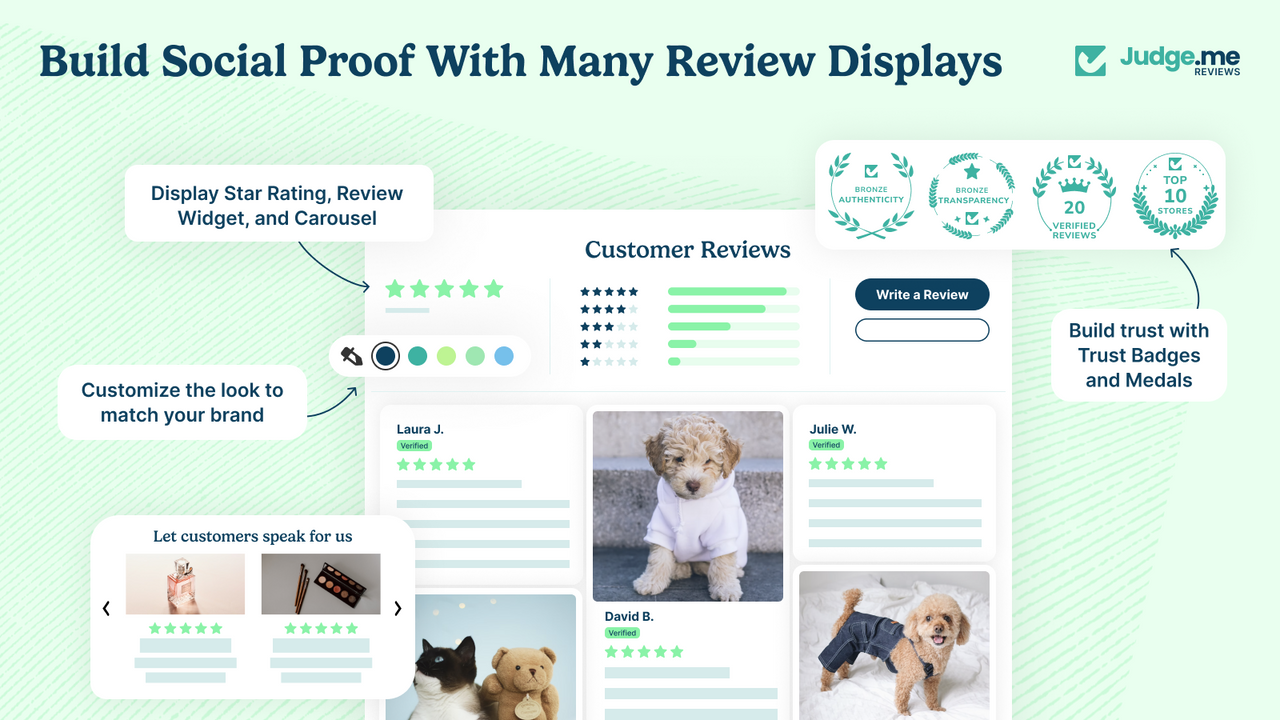
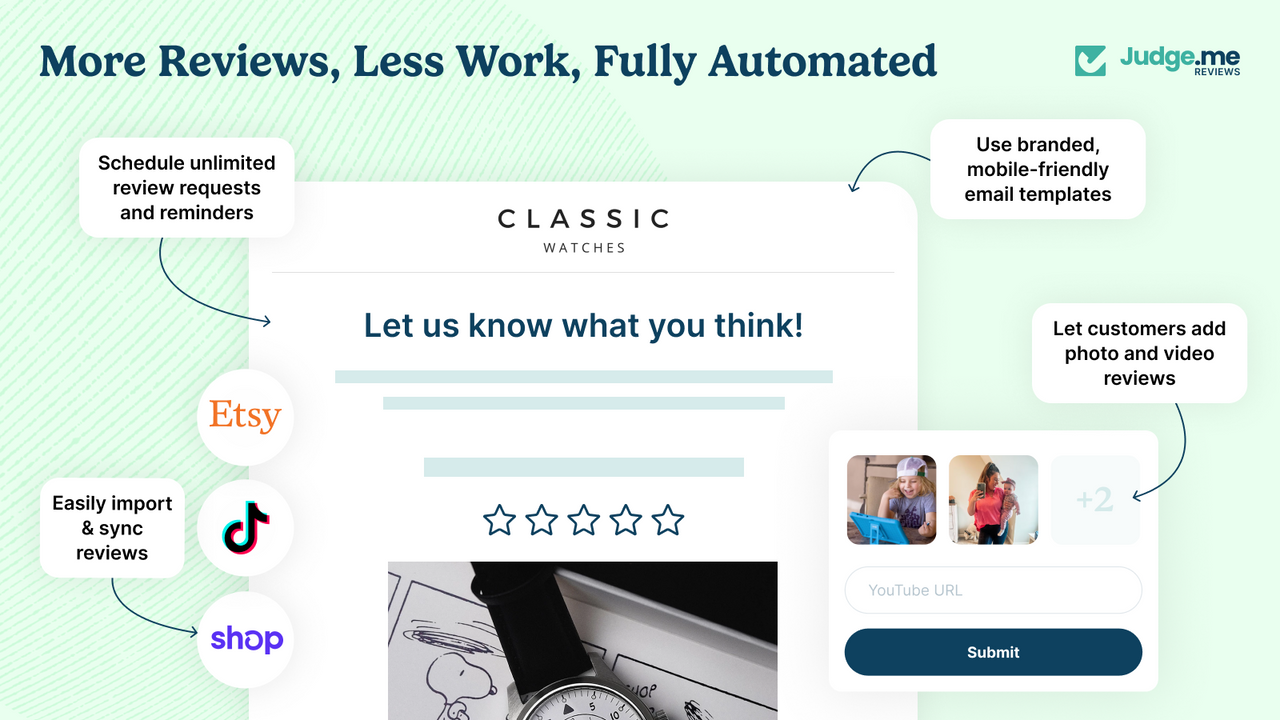
Judge.me holds the Built for Shopify badge and won a Shopify Build Award. Its free plan is famously generous: unlimited product and store reviews, unlimited photo and video review collection, all core widgets, Google Shopping sync with rich snippets, and an importer from competing apps — with no order caps whatsoever.
The paid plan, Judge.me Awesome at a flat $15 per month, is where the app becomes almost unfair competition. There is no order-volume pricing: $15 covers you at 200 orders a month and at 20,000. For that price you get AI-generated review replies and summaries, automatic translation into 38 languages, coupons and referral incentives, Q&A widgets, testimonial sliders, custom CSS, and syndication to Google Shopping, Meta and TikTok. Judge.me claims around 130 integrations, including Klaviyo, Gorgias, AfterShip, LoyaltyLion and PageFly, plus native hooks into Shopify Flow and Checkout.
Where Judge.me shines:
- Predictable pricing — a single flat plan means the app never punishes you for growth.
- Support speed — 24/7 support with an advertised ~40-second average response, confirmed by merchant feedback.
- Multi-language operations — auto-translation into 38 languages and an interface localized into a dozen-plus.
- Migration path — importers from Yotpo, Loox, Amazon, Etsy and AliExpress reduce switching cost to near zero.
Where Judge.me falls short: its design is functional rather than beautiful. The default widgets are clean but conservative; brands that want glossy, magazine-style UGC galleries will get better-looking results from Loox or Okendo with some custom CSS effort. Advanced visual merchandising — branded review stories, shoppable Instagram-style grids — is weaker than at the visual-focused competitors.
Integration picture: beyond the big names, Judge.me connects to 130+ apps including PushOwl, Smile.io, Squirkl, FotoRise and Omnisend, exposes webhooks and a public API, and supports Shopify Markets with localized review display. For agencies, the flat pricing also makes it the easiest app to standardize across client stores — one bill, one feature set, no per-client surprises.
📸 Loox — visual social proof with an AI engine
Loox has been around since 2015, and its entire pitch is that visual reviews — photos and videos from real customers — convert dramatically better than text. Everything in the product is built around collecting and showcasing them.
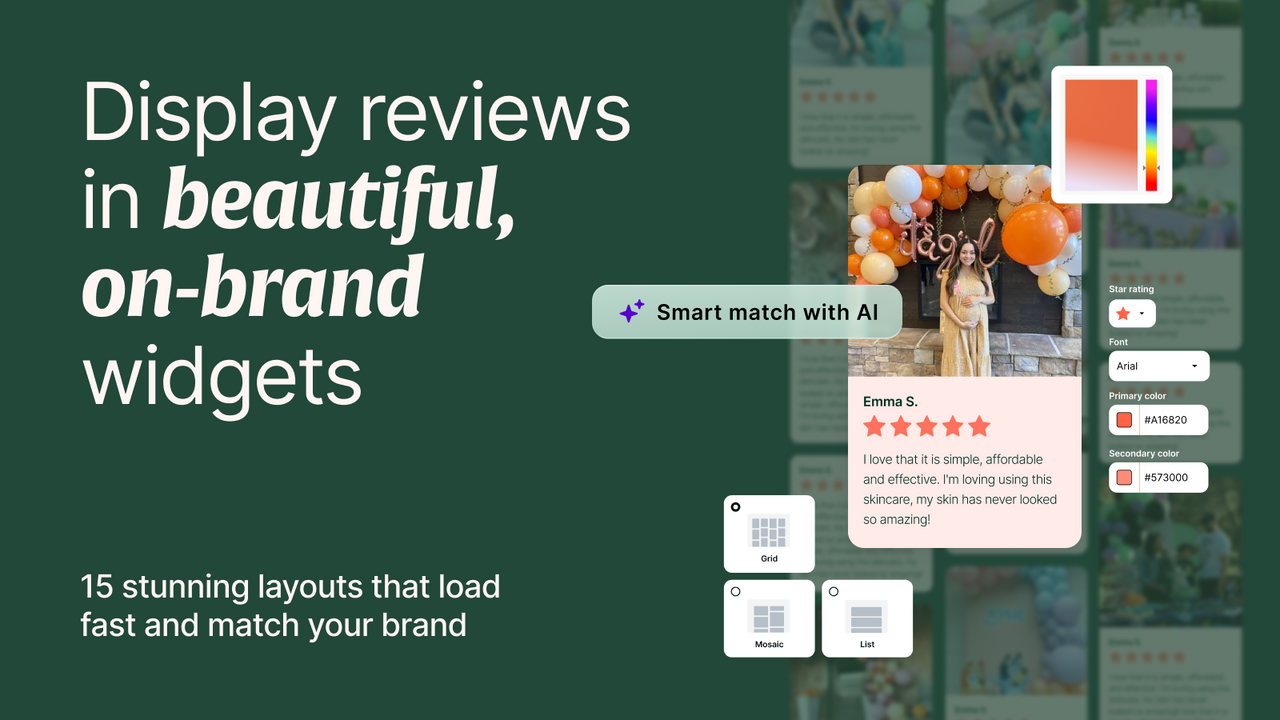
The free Beginner plan covers stores up to 500 orders per month with review-request emails and reminders, discounts for photo reviews, 17+ widget types, Google rich snippets, social post generation and Shop App syndication. The paid Convert plan at $49.99 per month adds the AI suite — Smart Sorting, Review Highlights, AI Summaries, Review Stories, AI Translations and automatic AI Replies — plus video reviews, reviews on bundles, referrals, syndication to Google, Meta and TikTok Shop, and API access. Base price includes 300 orders per month, each additional 300 adding $50. Unlimited at $299.99 removes caps and adds priority support.

Where Loox shines:
- Widget beauty — the best-looking galleries in the category out of the box.
- AI-powered merchandising — Smart Sorting surfaces your highest-converting visual reviews first; Review Highlights pull key quotes.
- International selling — AI translations plus Google, Meta, TikTok and Shop App syndication.
Where Loox falls short: if your products rarely inspire customer photography — industrial parts, supplements with regulatory constraints — you pay a premium for a visual engine you cannot fully use. Design customization beyond the presets needs some CSS confidence.
Integration picture: Loox syncs reviews to the Shop App and to Meta Shops, exports shoppable posts via Loox Studio, connects to Klaviyo and Omnisend for review-triggered email flows, and integrates with LoyaltyLion for photo-review rewards. QR-code review collection on packaging is built in — a feature usually reserved for enterprise tools.
🏢 Yotpo — the enterprise retention suite
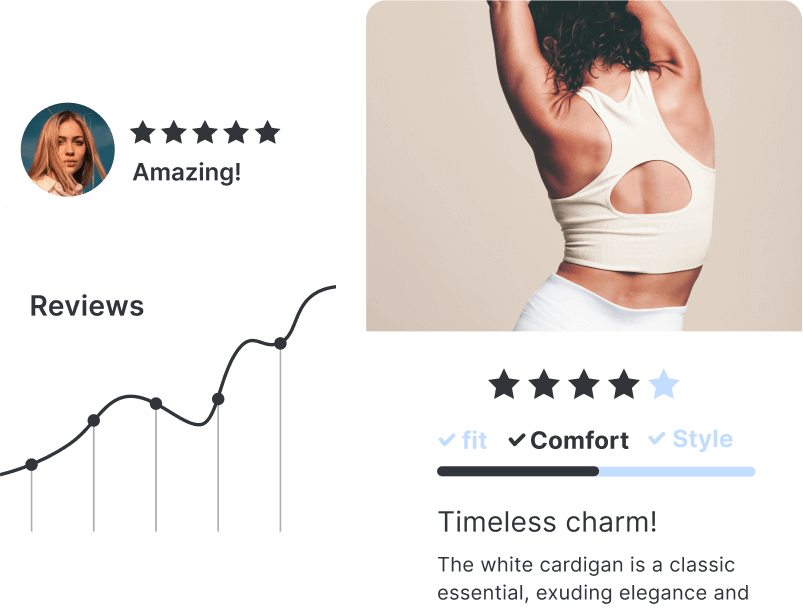
The free plan caps you at 50 orders per month but includes automated review requests, email templates, sentiment and profanity filters, and on-site display. The Starter plan at $15 per month unlocks photo and video reviews, Google rich snippets, Google Shopping Ads integration and the carousel widget — with a price that scales with order volume. The Pro plan at $119 per month adds Google Seller Ratings, custom review questions, AI summaries and smart sorting. Yotpo handles billing outside Shopify.

Where Yotpo shines:
- Syndication depth — Google Seller Ratings feed directly into your search ads; reviews also push to TikTok, Walmart and beyond.
- Suite effects — with Yotpo Loyalty and Yotpo SMS & Email, reviews, points and campaigns share one customer graph.
- Enterprise muscle — custom questions, advanced moderation, sentiment analytics and professional services.
Where Yotpo falls short: cost predictability is the recurring complaint — the bill grows precisely when the store succeeds. The interface is heavier than the modern challengers, and support paths are slower for smaller accounts.
Integration picture: Yotpo connects natively with Klaviyo, Facebook and Instagram, Google, PageFly, Shopify Flow and Checkout, and pushes review data into its own loyalty and SMS products. For merchants already inside the Yotpo ecosystem this is the strongest argument: one login, one support channel, one customer profile shared across reviews, points and campaigns.
✨ Junip — the minimalist built for Shopify
Junip is the youngest serious player here, and its philosophy is captured perfectly by a merchant review: "a lightweight review platform with all of the essential features and no bloat that drives up costs." When that merchant requested a missing feature, Junip built and shipped it within a week.
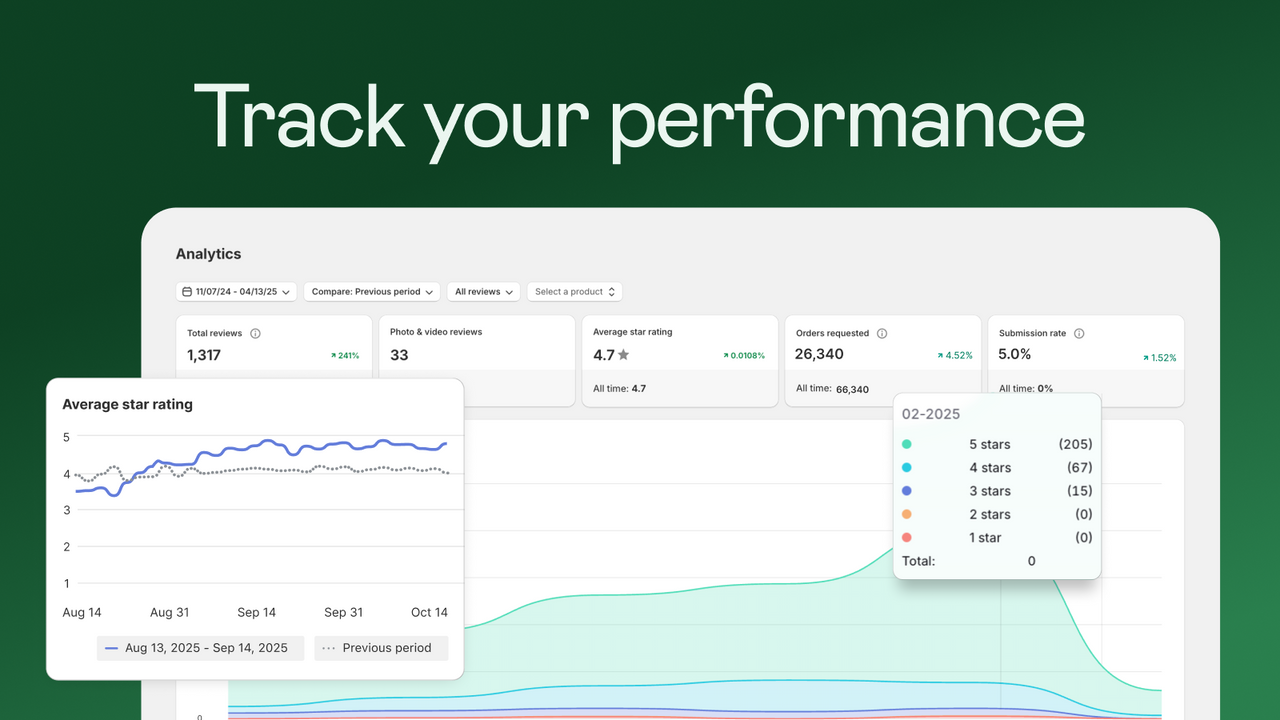
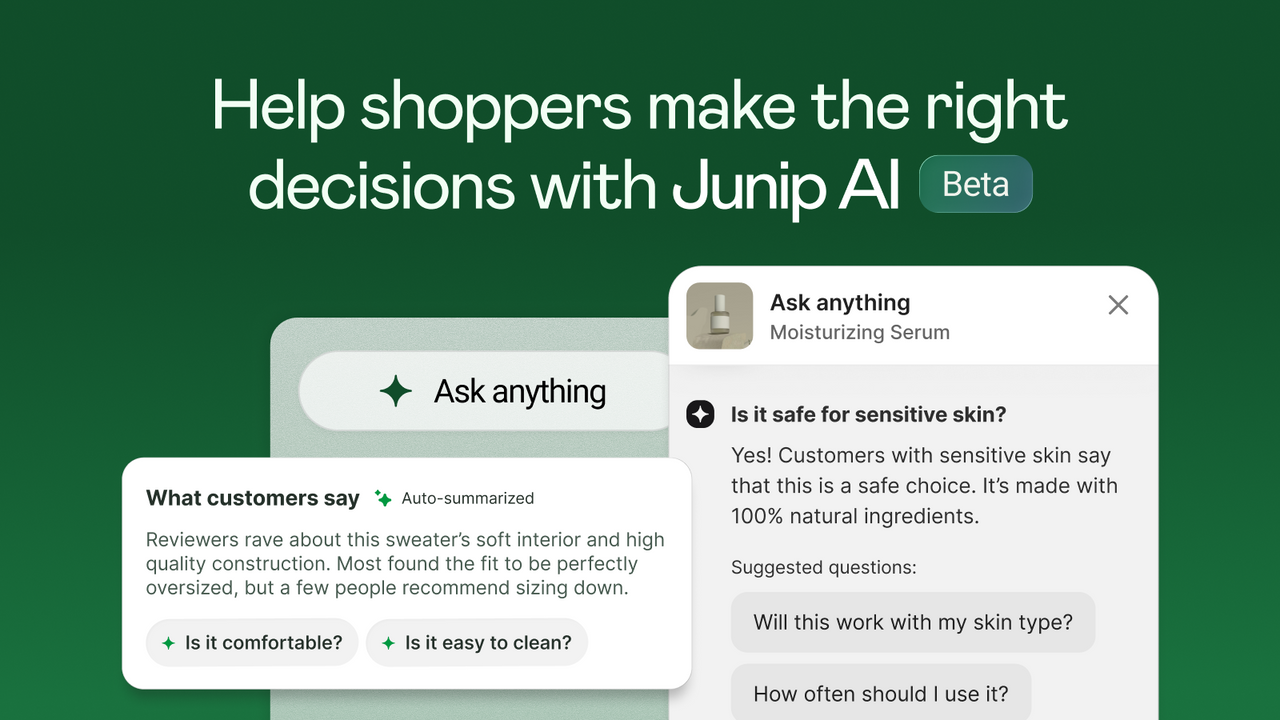
The free plan is genuinely unlimited: every plan covers unlimited orders and unlimited review-request emails, plus mobile-first submission forms, standard widgets and Google rich snippets. The Core plan at $29 adds photo and video reviews, incentives, owner replies and product grouping. The Growth plan at $79 unlocks official syndication to Google Shopping, TikTok Shop, Shop App and Meta Shops, plus Klaviyo and Postscript integrations and search with filters. The Premium plan at $299 brings Junip AI — an AI sales agent answering shopper questions from review data, AI summaries, multi-store support and API access.
Where Junip shines:
- Calm economics — $29 at 500 orders a month, $79 at 5,000, $299 with AI at any scale.
- Mobile-first collection — forms designed phone-first measurably lift completion rates.
- Modern syndication — official Google Shopping, Meta Shops, Shop App and TikTok Shop pipelines.
Where Junip falls short: the feature catalog is intentionally lean — no built-in loyalty, shallower coupon incentives than Judge.me, fewer display widget varieties than Loox. English-only interface limits non-English stores, and the integration catalog, while growing, is thinner than Yotpo's or Okendo's.
Integration picture: Junip officially integrates with Klaviyo, Rivo Loyalty, Google Shopping Reviews, Meta (Facebook & Instagram) Shops, Shop App, TikTok Shop, Shopify Flow and Checkout, with webhooks and API access on Premium. Its migration tooling accepts reviews from Yotpo, Judge.me and Okendo — the team has handled full migrations including photo assets, not just text rows.
📊 Okendo — enterprise analytics without Yotpo money
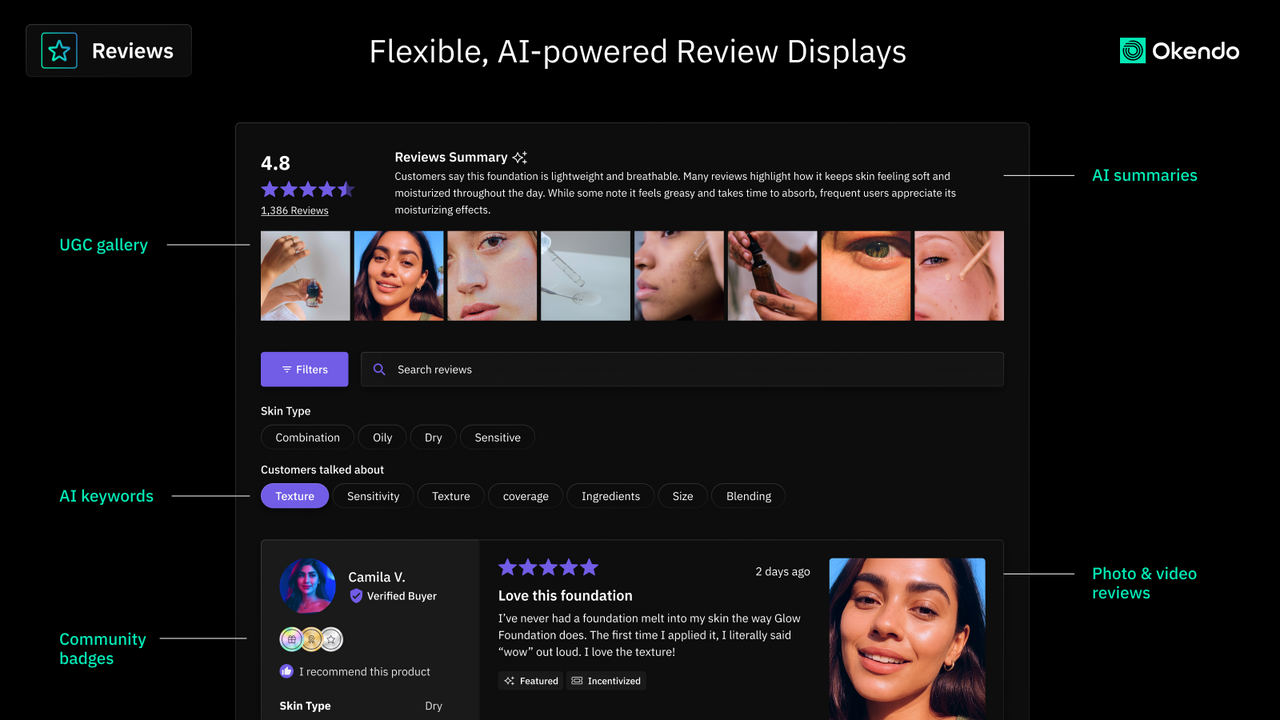
The free plan covers 50 orders per month with automated request emails, a smart review form, review rewards and Google SEO snippets. The Essential plan at $19 covers up to 200 orders. The Growth plan at $119 raises the ceiling to 1,500 orders and adds AI summaries and keywords, TikTok Shop syndication and a Q&A widget. The Power plan at $299 goes to 3,500 orders and includes review campaigns, advanced CSS, email and SMS integrations, and managed onboarding.
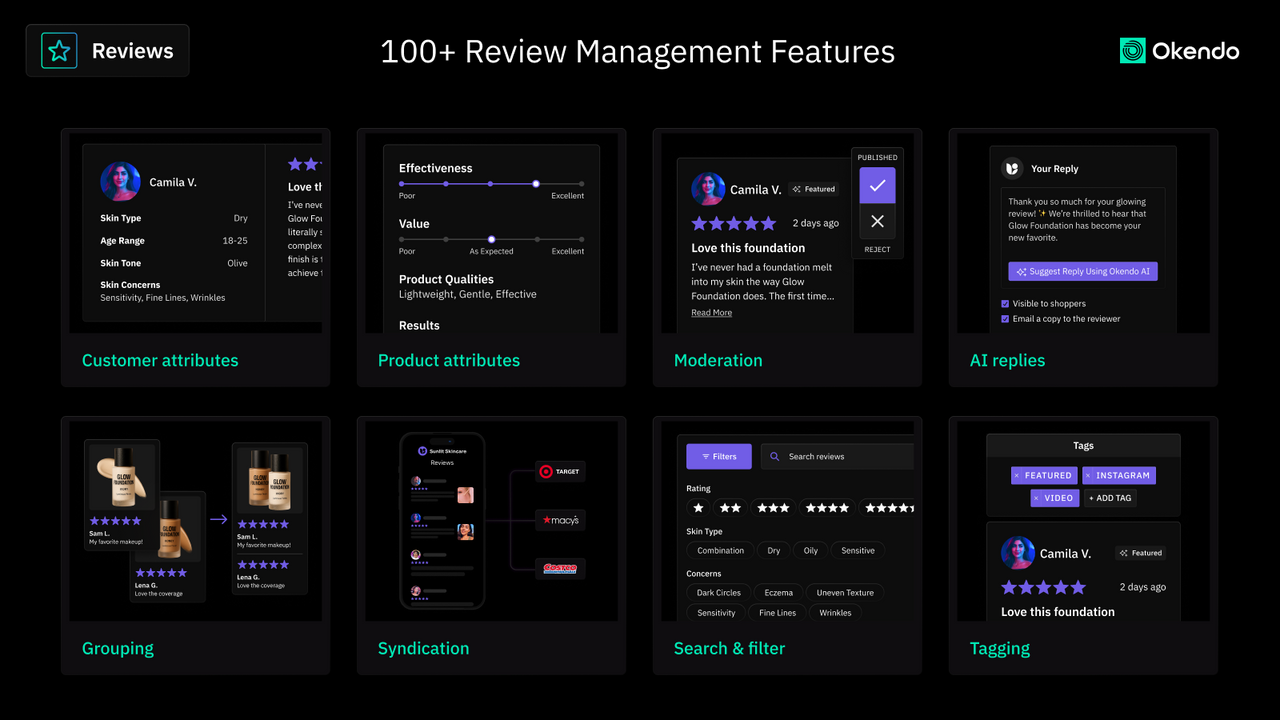
Where Okendo shines:
- Attribute-rich review data — structured attributes per product power genuinely useful filtering and analytics; the feature enterprise merchants cite most.
- Syndication breadth — official pipelines to Google, TikTok Shop, Shop App and Walmart match Yotpo's reach.
- Suite cohesion — the review-rewards engine is deeper than any standalone rival's coupons.
Where Okendo falls short: more configuration surface than Junip or Judge.me, English-only documentation, and volume-based tiers you will outgrow.
Integration picture: Okendo connects to Klaviyo, Gorgias and Postscript, syndicates to Google, TikTok, Shop and Walmart, and ships Shopify POS, Flow and Checkout support among 50+ integrations. Its unified profile ties review submissions to loyalty activity and quiz answers — the data foundation for segmented retention campaigns.
🎁 Stamped — the veteran with a loyalty twist
The reviews product scales through volume tiers — $99 for 1,000 orders, $199 for 5,000, $399 for 20,000, $599 for 50,000 and $799 for unlimited — and includes photo and video reviews, Q&A, Google Shopping syndication with rich snippets, automated email and SMS request campaigns, and analytics on conversions and repeat purchases. A separate loyalty product starts at $299 per month with points, discounts, referrals and VIP tiers.
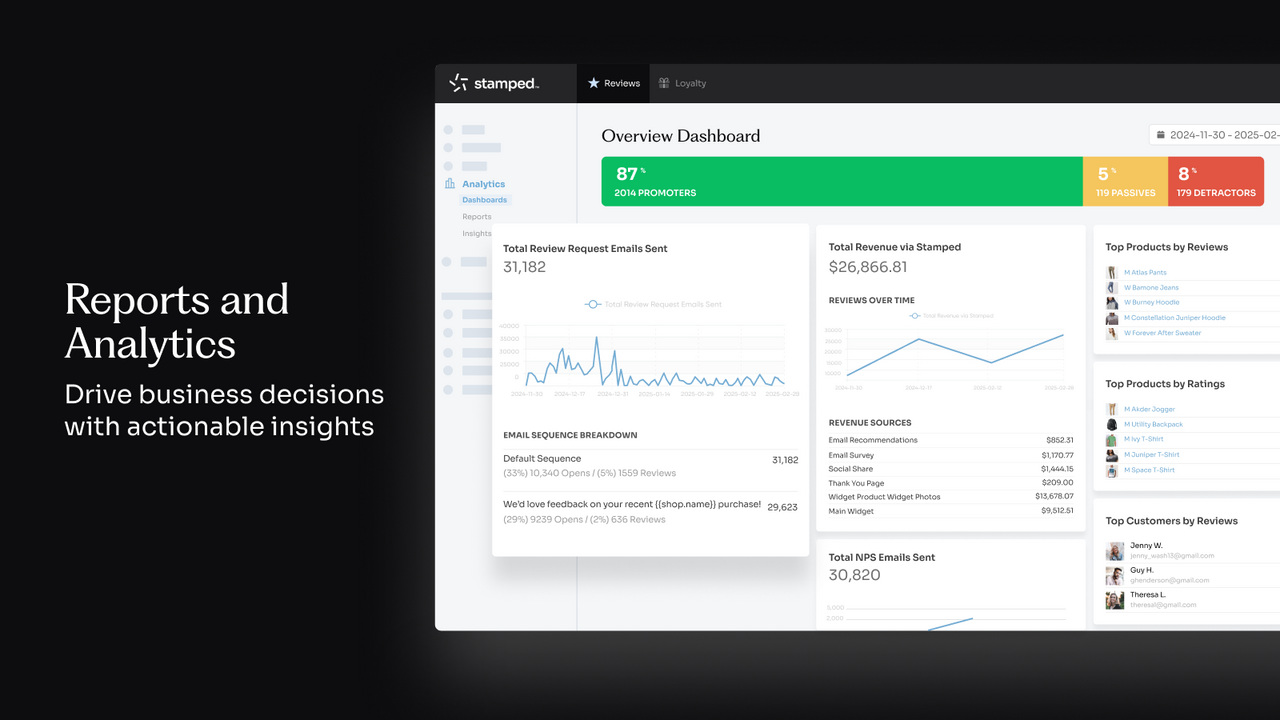
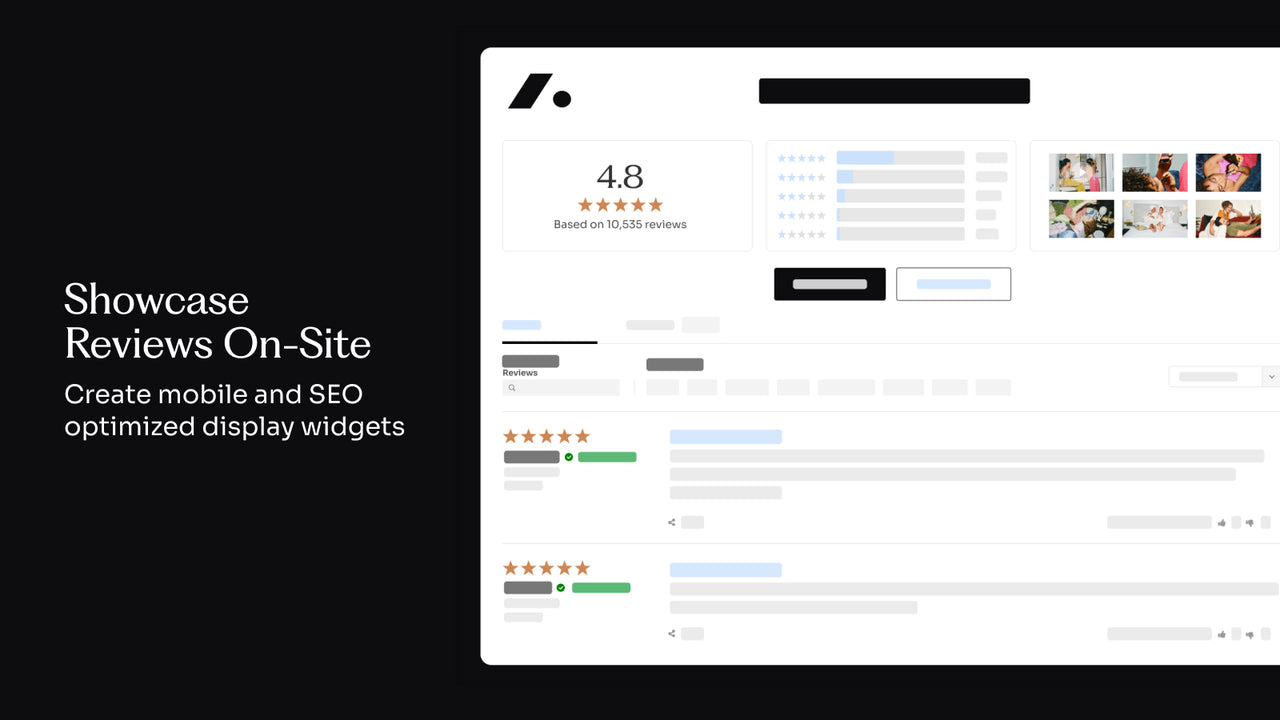
Where Stamped shines:
- Reviews plus loyalty under one roof at a lower entry point than Yotpo or Okendo suites.
- Mature Q&A and campaign tooling — email and SMS request flows are more configurable than most rivals'.
- Subscription-friendly integrations — strong Recharge and Klaviyo support.
Integration picture: Stamped pairs with Klaviyo, Gorgias and Recharge (critical for subscription brands), syndicates to Google Shopping with rich snippets, and supports Shopify Flow and Checkout. Its email and SMS request campaigns can be triggered by order events with custom segmentation — the most configurable collection automation in this comparison.
🛒 Ali Reviews — the dropshipping workhorse
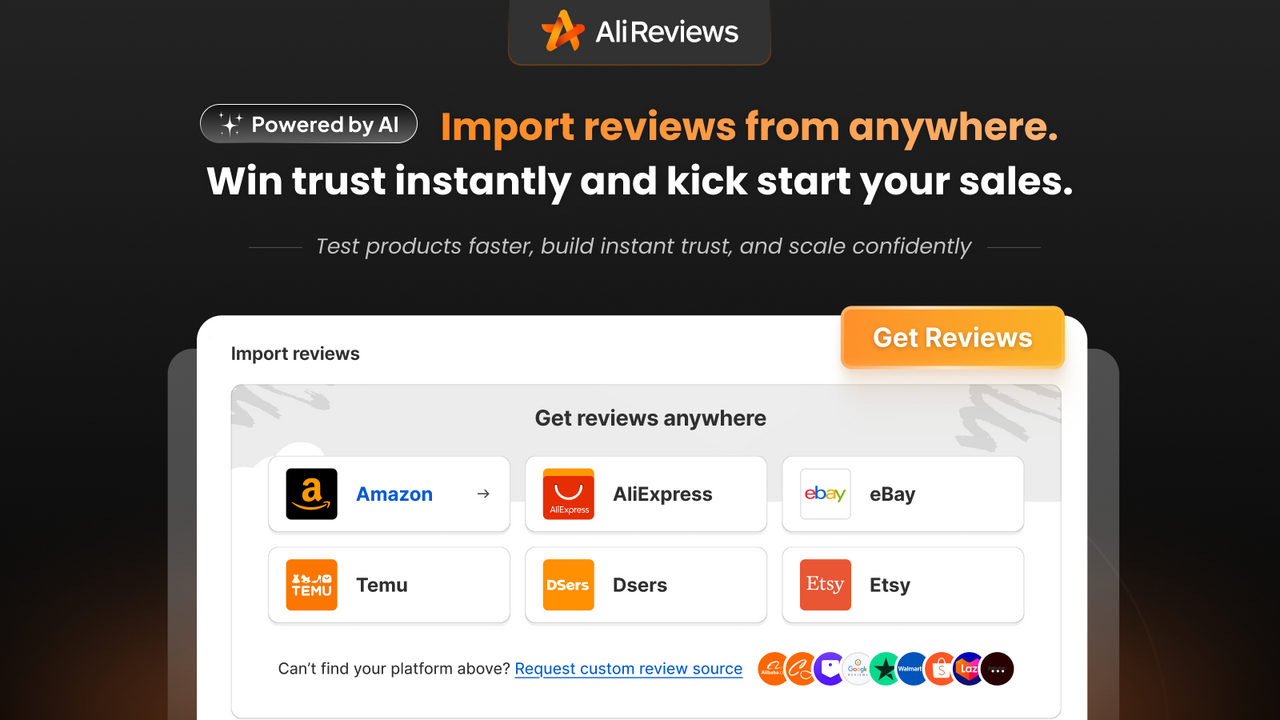
Ali Reviews (formerly Kudosi) is built for one job: making a new dropshipping store look trustworthy fast. The free plan allows 10 published reviews per product, unlimited AliExpress imports, unlimited email requests and basic widgets with translation. The Basic plan at $14.95 raises the limit to 150 reviews per product and adds Amazon/eBay/Temu/Etsy sources, rich snippets, media galleries, popups and carousels, review replies, Q&A and dynamic discounts. The Growth plan at $24.95 jumps to 1,500 reviews per product with AI summary highlights and advanced translation; Advanced at $49.95 removes all limits.
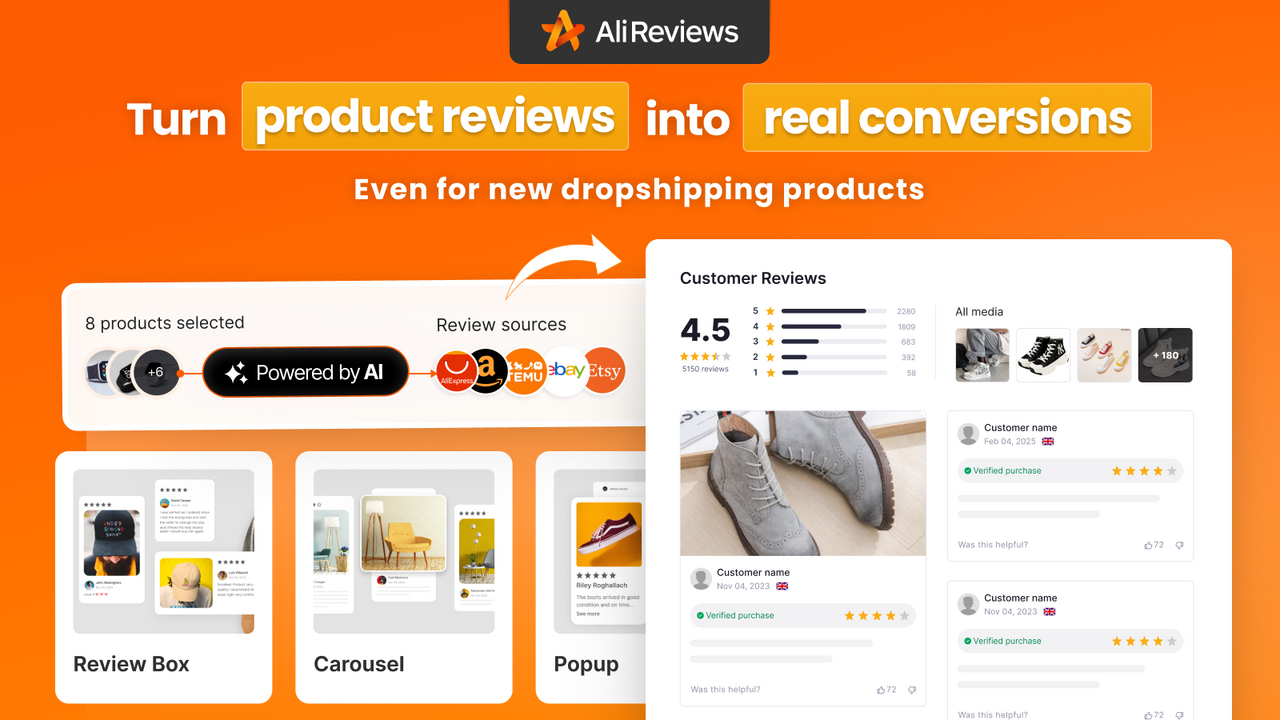
Where Ali Reviews shines:
- Fastest path to social proof — import dozens of reviews per product in minutes; a new store looks established on day one.
- Genuine AI translation — Gemini-powered translation makes imported reviews readable and natural.
- Low price floor — the full feature set lands at $49.95, cheaper than any rival's comparable tier.
Where Ali Reviews falls short: imported reviews are not verified purchases in your own store — sophisticated shoppers and Google's policies can penalize careless use, so curate. Widget design is solid but not Loox-level, performance optimization is middling, and the review feed is dominated by short support-praise blurbs rather than substantive feedback. The vendor's branding changes (Kudosi ↔ Ali Reviews) occasionally unsettle long-term users.
Integration picture: Ali Reviews plugs into Shopify Flow, PageFly and GemPages page builders, imports through its own AliExpress bridge with bulk AI processing, and exports to CSV for migration. The widget system covers boxes, popups, carousels and media galleries, with dynamic discount incentives for photo and video submissions on paid tiers.
🧭 Which review app should you choose? Five scenarios
Scores are one thing; real-world fit is another. These are the five most common situations we see:
🔄 Migrating between review apps without losing reviews
Switching costs are lower than most merchants fear, and every app in this list has a story here. Judge.me ships importers for Yotpo, Loox, Amazon, Etsy and AliExpress. Junip offers official migration from Yotpo, Judge.me and Okendo — and its team has been known to hand-roll migrations for merchants. Ali Reviews supports CSV import from Loox, Yotpo and Judge.me. Loox advertises easy migration and import from other apps, and Okendo runs managed onboarding on higher tiers that includes data migration.
One more practical note: photo assets are the slow part of any migration. Text rows move in minutes, but images usually transfer as URLs pointing at the old app's CDN — some apps re-host them automatically, others keep hotlinking. Ask the vendor explicitly how photo storage works post-migration, because a broken image in a review widget is worse than a missing review.
❓ Frequently asked questions
🔎 Final verdict
Comments
One practical warning about Ali Reviews from running a dropshipping store for two years: curate aggressively. Importing the default 50–150 reviews per product looks spammy and Tank_conversion — the sweet spot is 15–30 well-rated imported reviews per product, with the obviously fake ones (identical wording, five-star-only profiles) filtered out. Gemini translation is good, but for your top two markets it pays to hand-polish the top 5 reviews.
And agree with the article on the migration path: we moved our curated reviews to Judge.me with the CSV import in under an hour, and Google re-indexed the star ratings within two weeks.
A caveat from the headless corner for anyone considering Junip: the API access is locked behind the $299 Premium plan, so if you run a Hydrogen or custom storefront, the lower tiers are widget-embed only. We ended up on Premium and the API is solid, but budget for it — on Judge.me the equivalent JSON endpoints are available on the $15 Awesome plan, which stings a bit when comparing the two.
That said, Junip's submission forms really do convert better on mobile — our completion rate went up by roughly a third after switching the collection flow to them.
Addition on Okendo from real usage: the underrated feature is not the reviews themselves but UGC rights management. When customers submit photos, Okendo tracks consent so you can legally reuse those images in ads, emails and product pages — something Judge.me and Loox handle much more crudely. If you plan to run your customers' photos as ad creative, factor that into the Okendo vs Loox decision.
Their quizzes product is also genuinely useful for skincare and supplements — it feeds structured data back into the same customer profile as the reviews.
Running a beauty brand on Loox here. One thing the article doesn't mention: most of these apps give two months free on annual billing, and vendors quietly push monthly plans because churn is higher. Before you pick a tier, ask for the annual price — on Loox Convert that is roughly $500 saved per year, and the same logic applies to Okendo and Stamped.
Also worth knowing: Loox's review-request emails support custom sender names and logos on every plan, which measurably lifted our submission rate versus the default branding.
Useful breakdown — one important SEO nuance you hinted at but worth spelling out. Since Google's 2019 policy update, self-serving review rich snippets are ignored for Organization and LocalBusiness markup, but Product-schema review stars on product pages still show. So review stars in organic results are absolutely still a thing for e-commerce — just don't expect stars on your homepage or about page.
Also, in our experience Judge.me widgets keep Core Web Vitals green even past 5,000 reviews per product, but make sure you enable lazy loading and keep the all-reviews page paginated.